
IP Has Taken Over Streaming (Plus, A Sanity Check on Netflix’ Actual 2025 Film Performance)
The Streaming Ratings Report for 21-July and 28-July-2025
(Welcome to my weekly streaming ratings report, the single best guide to what’s popular in streaming TV and what isn’t. I’m the Entertainment Strategy Guy, a former streaming executive who now analyzes business strategy in the entertainment industry. If you were forwarded this email, please subscribe to get these insights each week.)
Between school starting, summer vacations and more, we’ve got one more Streaming Ratings Report double issue this week, then we’re all caught up with streaming data. The big news is that I’ll be sharing all the flops, bombs and misses for the first half of the year later this week.
We’ve got a lot of stuff to discuss (I already split out my KPop Demon Hunters check-in earlier this week) including a trio of horror films on streaming, Sofia Carson’s latest romcom, some very pricy “misses of the week” on TV, the Taylor versus Serrano fight, The Hunting Wives and Leanne on Netflix, some shocking legacy media stats, and a whole lot more.
But we start with Netflix’s records-smashing sequel, and the best freely available data cuts you’ll find. Let’s dive right in!
(Reminder: The streaming ratings report focuses on the U.S. market and compiles data from Nielsen’s weekly top ten viewership ranks, Luminate’s Top Ten Data, Showlabs, TV Time trend data, Samba TV household viewership, company datecdotes, and Netflix hours viewed data, Google Trends, and IMDb to determine the most popular content. While most data points are current, Nielsen’s data covers the weeks of July 21st to August 3rd.)
Film - A New Winner for Biggest Film Opening of Streaming History
As I wrote earlier this week, I’m allergic to hype. It causes me to burst out in data hives.
So I will say one narrative this year seems…wrong to me. Basically, some folks have concluded that “Netflix is utterly crushing the traditional studios in movie output this year” because…they have two hits. So just take a gander at this list:
The Electric State
The Old Guard 2
Kinda Pregnant
Havoc
Plankton: The Movie
My Oxford Life
Fear Street: Prom Queen
The Life List
I’d call four of those films outright flops, and the rest misses. None of them broke above my 20-million-hours-in-a-single-week hit threshold, and most didn’t get above 15 million hours.
Then there are the, being charitable, “fine” films:
Madea’s Destination Wedding (peaked at 19.9 million hours on Nielsen)
Straw (peaked at 20 million)
Nonnas (peaked at 14.1 million, but made the charts for four weeks)
Again, I’d call those performances fine, but not huge.
So, in that context (and again, that’s just Netflix’s notable films, excluding most documentaries and foreign and smaller titles...but stayed tuned for next week when I cover every film flop from every streamer in the first half of 2025), Netflix has had two indisputable hits this year (Happy Gilmore 2 and KPop Demon Hunters), and one other good performance (Back in Action).
This is frankly, “The Argylle Treatment” in effect, with a dose of mild amnesia for how popular Lilo & Stitch and A Minecraft Movie actually were. While every theatrical flop gets dissected on podcasts, live-streams and write-ups, Netflix’s misses mostly just get…ignored. (The notable exception was The Electric State, which is maybe Netflix’s first film to get such a treatment…ever.) So when they do have two hits, everyone celebrates Netflix (especially traditional media outlets), but then doesn’t bother to make a simple list like I just did.
Anyways, I’m here, today, to talk about a HUGE hit for Netflix. But that’s the context I wanted to provide first.
Hey, Entertainment Strategy Guy, Get To It: How Did Happy Gilmore 2 Do?
Oh, wow, Adam Sandler’s follow-up to his iconic 1990s film smashed it on the viewership charts. Let’s run through a few accolades.
First, it actually joined the “Forty Million Hour” club, defined as a show, special or film that eclipses 40 million total hours in one week. Even most Amazon football games fail to reach this bar, so yeah, it’s a big deal.
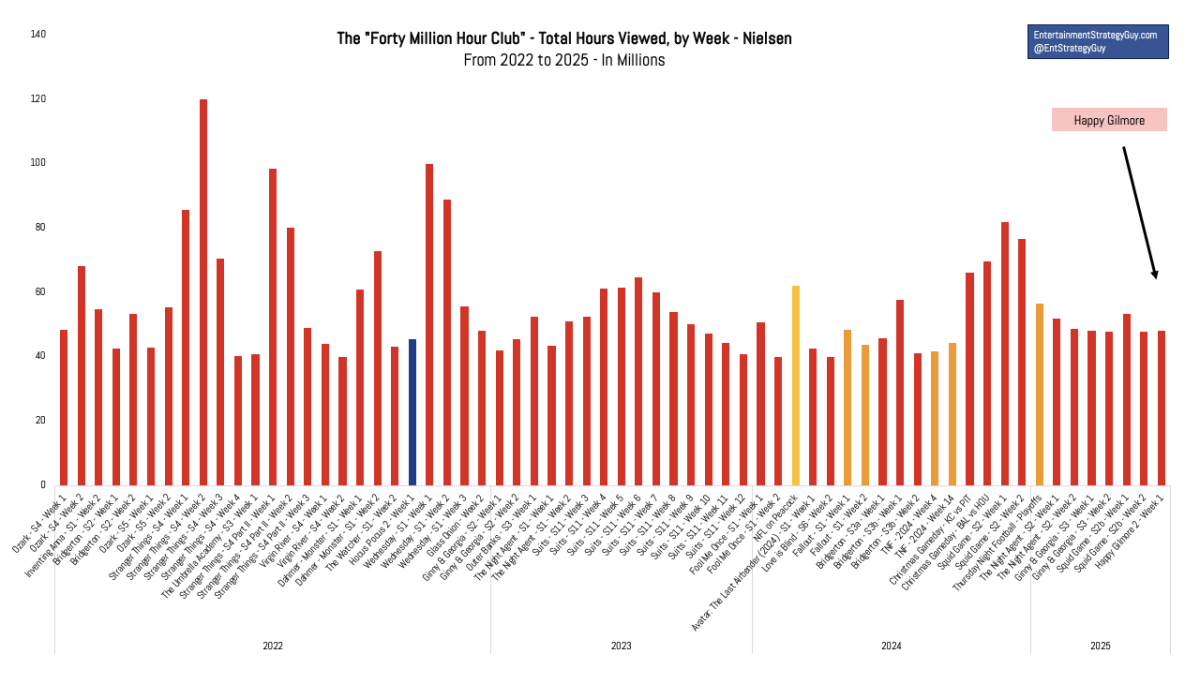
Since it bested the 40 million mark, that means, by default, it landed in the film “30 million hour” club, the slightly lower bar for elite performance on streaming for films:
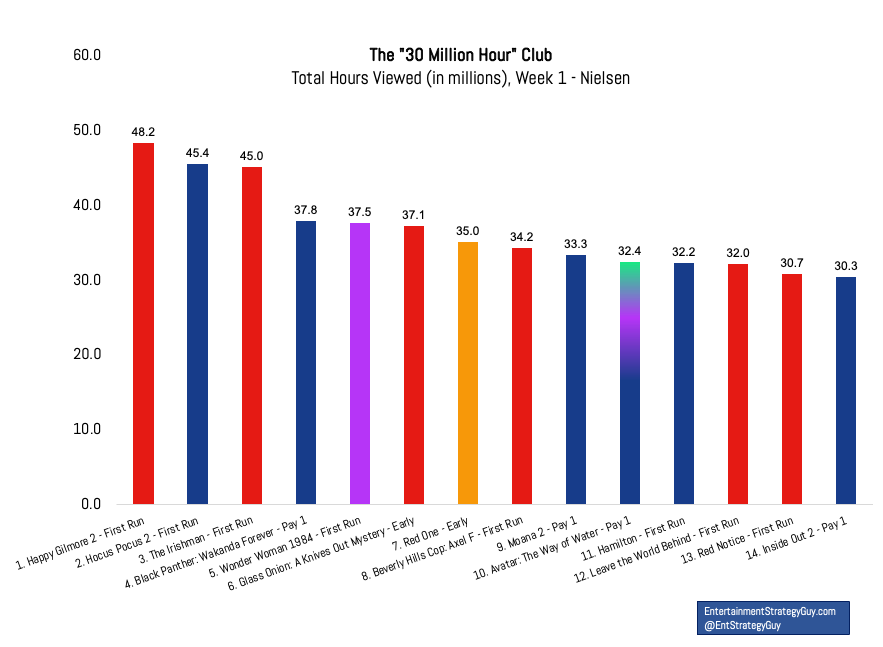
These are the elite of the elite films. (Of the hundreds of films ever released on streaming, only 14 movies have eclipsed 30 million hours, only 45 have eclipsed 20 million hours in their first week/weekend, and only three more have eclipsed 20 million hours in their second week.)
But here’s the real fun change: the 30 million hour club is no longer filled with original films, as it was in years past. Now that theatrical films charge up the charts, IP-derived films just crush it:
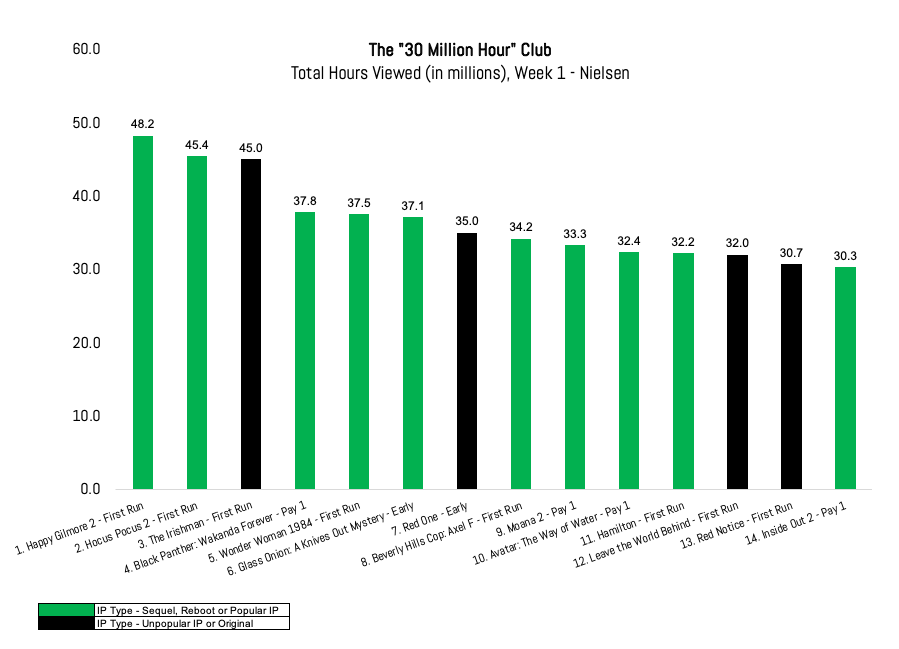
Even Netflix seems to have caught the IP bug. Just glancing at their top five films now, Happy Gilmore 2, Knives Out: A Benoit Blanc Mystery and Beverly Hills Cop: Axel F are all sequels! Whenever KPop Demon Hunters 2 comes out, it will likely join that club, if not best it entirely.
Samba TV had similarly good numbers for Happy Gilmore 2, saying 4.7 million households watched it in the first three days. That’s tremendous, and one of the biggest openings of all time in that time frame, ahead of Red Notice (4.2 million households) and way ahead of others like You People (2.8 million). It also smashed it on Luminate (see below).
One last look? Sure. Here are Adam Sandler’s films on Netflix, ranked by Nielsen performance.
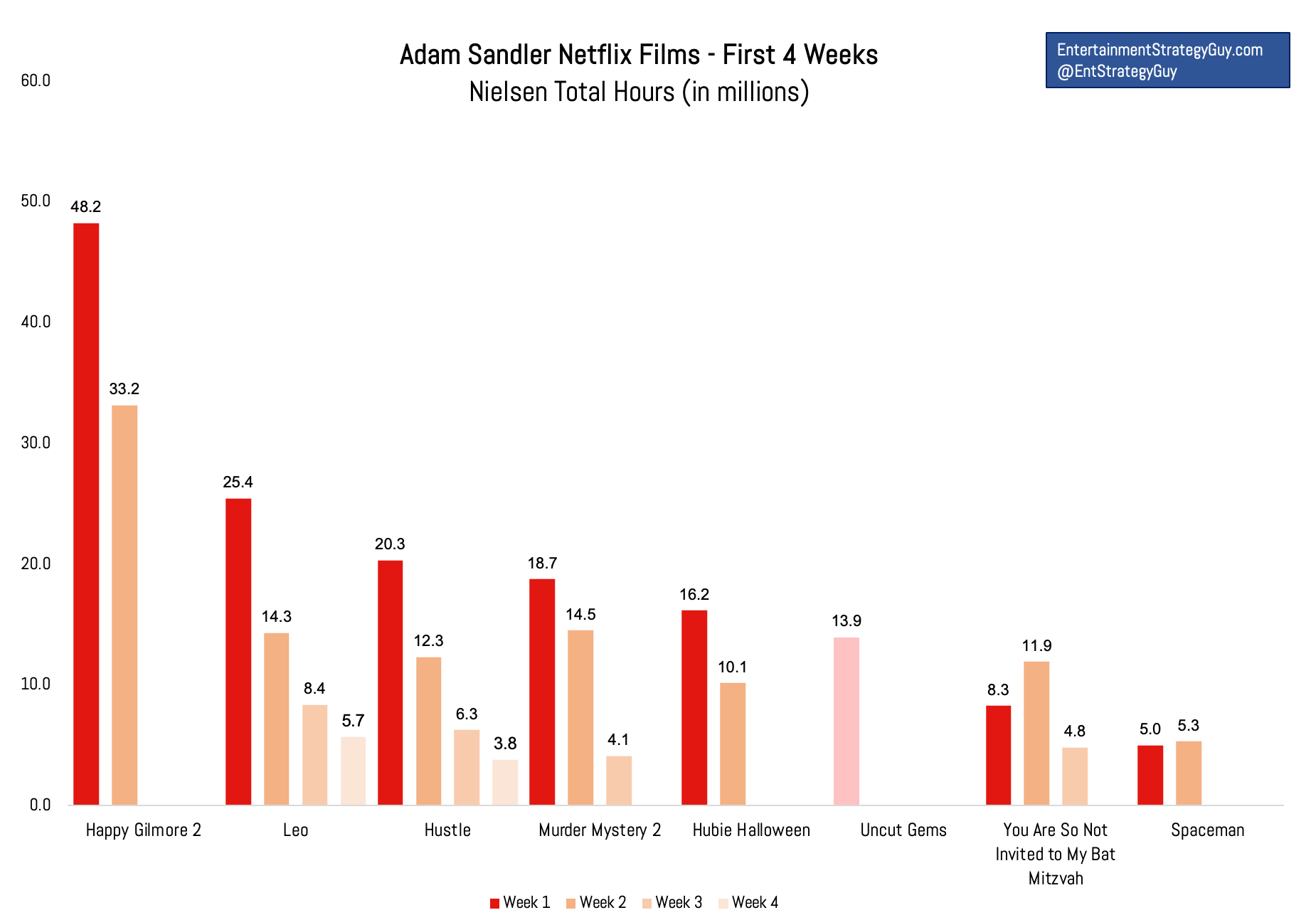
(Not to do the “toot my own horn” thing, but seriously folks, where else do you see four charts, in a row, for FREE!!!, like those? That’s more in-depth analysis than any other free articles on the inter-AI-web-o-spheres. Plus, there are over twenty more images for paid subscribers in the rest of the newsletter.)
Now, some quick caveats. First, like, frankly, most Netflix titles, it’s not clear customers love this new film. It has a 6.1 on 91K reviews on IMDb, which is below average, though not “hated”. Second, at first I saw some budgets that this movie only cost $30 million. At that number, wow, that’s a great performance. Then I saw the Wall Street Journal report that this cost at least $152 million in production, meaning with backend and whatnot, we’re probably looking at a $200 million film. In other words, even Netflix’s super hits still tend to cost a pretty penny.